
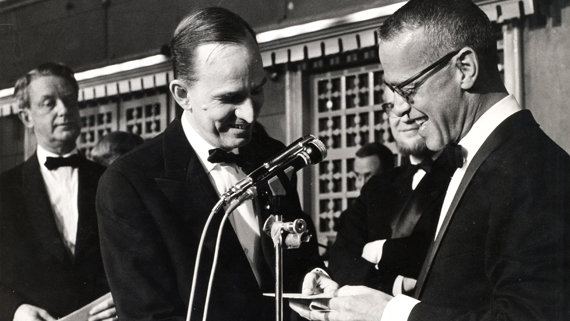
Harry Schein hands over the prize check to Ingmar Bergman during 1964 film award.
In a country characterized by Lutheran zeal and social utopia, the nowadays-mandatory film gala appeared comparatively late. Not until 1964, Swedish filmmakers were first awarded for outstanding contributions. It took an inventive aristocrat, Vienna-born Jew Harry Schein, to make the Guldbagge Awards come true, soon after he created the National Film Agreement and the Swedish Film Institute.
Named after a beetle also known as rose chafer, the Guldbagge statuette was designed by Karl-Axel Pehrson to weigh around 1.2 kg. Having its body chased in copper, then enamelled, real gold is finally added to give the Guldbagge its distinctive shimmer.
The notorious and immensely prolific Harry Schein appointed himself as the chair of the first jury, selecting Ingmar Bergman’s The Silence as Best Film, with Raven’s End merely as runner-up (in later critics’ polls Bo Widerberg’s film has often been picked as the best Swedish film ever). Schein’s spouse Ingrid Thulin won the award for Best Actress in The Silence, whereas Keve Hjelm won for Best Actor in Raven’s End. Three awards were enough to celebrate an exceptional year – even today, fifty years later, unrivalled.
In 1964, Swedish cinema stood on the verge of what was later dubbed the second Golden Age, whereas the first one occurred in the early 1920s. This silent era is probably the most recognized abroad, mainly on its own artistic terms, partly because numerous countries were experiencing analogous 1960s movements in the wake of the French Nouvelle Vague.
If Victor Sjöström, Mauritz Stiller and Greta Garbo brought about the first Golden Age in the 1920s, the second was surely engendered in Ingmar Bergman’s collected works. Bergman’s international achievements of the late 1950s inspired Swedish cinema on several levels. People slowly began to realise that artistic merit could actually pay dividends.
The National Film Agreement appeared under the strict guidance of Harry Schein in 1963 – Bergman was probably his spiritual deputy – an agreement that paved the way for other Swedish directors to step onto the world stage: Bo Widerberg, Jan Troell, Vilgot Sjöman, Mai Zetterling and later Roy Andersson – many of whom explicitly distanced themselves from Bergman’s film-making. And despite his dominance, Bergman never achieved the same recognition in Sweden as abroad, a fact that is also reflected in the Guldbagge Awards history. Notably with five awards, first-rate director and cinematographer Jan Troell has earned one more statuette than Bergman. The first came with his directorial debut This Is Your Life in 1967, another rare moment in Swedish film history.
In 1969, social democrat Olof Palme came to host his second Guldbagge ceremony, one day before he became the Swedish prime minister, and 27 years before he was murdered on the open street of Stockholm, after watching The Mozart Brothers, a Susanne Osten film later awarded a Guldbagge Award for Best Direction.
Around 450 statuettes have been handed out over the years. Though in 1971, the jury found the quality of the films so poor they decided to abstain. Similarly, in 1980, the Best Actress category was excluded, in a protest against the weak parts offered to female actors that year.
The mid-1980s became of significant international interest in the Guldbagge history, which has not always been the case. In 1986, Lasse Hallström won Best Film for My Life as a Dog, a film that later received both Oscar nominations and a Golden Globe for Best Foreign Language Film. The year after, Andrei Tarkovsky posthumously had the Guldbagge Award for Best Film. His last work The Sacrifice was produced and shot in Sweden with a local crew. One year later, Danish director Bille August was given the same award for Pelle The Conqueror, before moving on to win the Palme d’Or in Cannes as well as an Oscar for Best Foreign Language Film.
In 1997, Lukas Moodysson made an outstanding entrance, winning for Best Film, Manuscript and Direction for his debut Show Me Love. In one of the most famous victory speeches, Moodysson heckled the film establishment and particularly a long-since retired Harry Schein. In 2000, veteran Roy Andersson had his three first Guldbagge Awards for his awaited comeback Songs from the Second Floor, also the latest Swedish film to be picked for the main section at Cannes Film Festival, where it shared the Jury Prize.
Nowadays, 19 Guldbagge Awards are handed out in comparison with the three original. The most recent trend stems from female newcomers having international breakthroughs and also winning the most prestigious awards: Lisa Langseth for Pure, Pernilla August for Beyond, Lisa Aschan for She Monkyes and last year Gabriela Pichler for Eat Sleep Die.
Jon Asp
2013